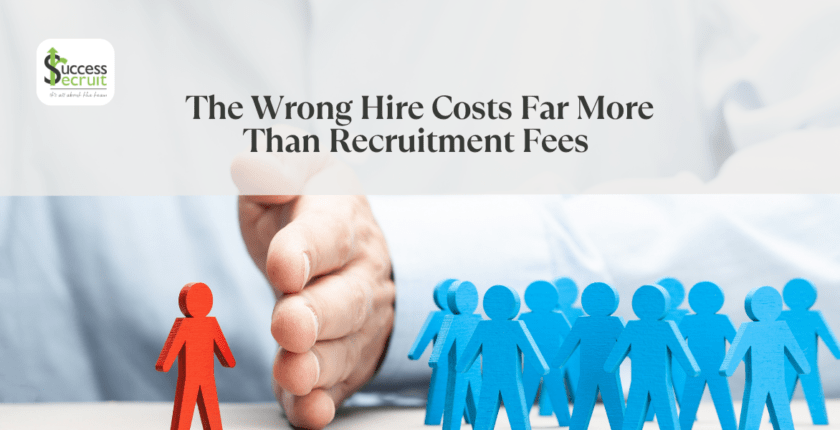
The Wrong Hire Costs Far More Than Recruitment Fees
By Success Recruit | Recruitment That Puts People First
One of the conversations that still comes up frequently within recruitment is cost.
Businesses understandably want to make sensible financial decisions, especially within uncertain economic climates, and recruitment fees can sometimes feel like an area to minimise or reduce. That instinct is not unreasonable – budgets are real, resources are finite and scrutinising spend is a sign of responsible leadership.
But what is often overlooked within that conversation is the true cost of hiring the wrong person.
And it is far higher than most businesses realise, not just financially, but in ways that are harder to measure and far slower to recover from.
The Real Cost Of A Poor Hire Does Not Sit Neatly In A Spreadsheet
When businesses calculate the cost of a bad hire, they tend to focus on the obvious: the time spent advertising, interviewing and onboarding, the salary paid during a period of underperformance, and the cost of having to start the process again.
Those numbers are significant on their own.
Research consistently suggests that the direct cost of replacing an employee can range from one to three times their annual salary when you factor in lost productivity, management time, training investment and the disruption of running a search process twice. For senior roles, that figure rises considerably.
But the numbers only tell part of the story.
The impact of a poor hire rarely sits neatly within a spreadsheet. It shows up in other ways – quieter ways that are harder to quantify but no less damaging to a business.
The Hidden Costs Most Businesses Do Not Talk About
It shows up in team morale
When a new person joins a team and the dynamic shifts in a way that feels uncomfortable, people notice immediately. Communication becomes more guarded. Collaboration becomes more effortful. The easy, natural rhythm that a settled team had built together starts to feel strained.
People do not always raise this directly – particularly if they are not sure yet whether their instinct is fair. Instead, they absorb it. They manage around it. They adapt their behaviour to accommodate the friction. And that quiet adaptation takes energy that would otherwise go into the work itself.
It shows up in leadership time
One of the most underappreciated costs of a poor hire is what it demands of the people managing it. Leaders who had been focused on growth, strategy and supporting their teams suddenly find themselves navigating performance conversations, managing conflict, monitoring behaviour and trying to hold things together around a hire that is not working.
That is not just costly in hours. It is costly in mental load, in motivation and in the confidence of a leadership team that trusted a hiring decision and now has to deal with the consequences.
For leaders who are already carrying significant responsibility, this additional pressure has a real impact on their own wellbeing and that matters.
It shows up in quiet disengagement
When the atmosphere within a team shifts, employees do not always leave. Sometimes they stay but they disengage. They put in what is required, but no longer go beyond it. They stop bringing ideas. They stop investing emotionally. They arrive and they leave, and the business loses the very thing it was trying to build: a team of people who genuinely care about the work and each other.
Disengagement is one of the most expensive problems a business can have, and it is almost always invisible until it is already deeply embedded.
It shows up when the best people start looking elsewhere.
Perhaps the most painful cost of all. When the culture of a team is disrupted — when psychological safety is reduced, when the atmosphere shifts, when good people feel like the business they joined is no longer quite the same — some of them begin quietly considering their options.
These are rarely the people who have been underperforming. They are often the most capable, the most self-aware, the most in-demand. The people a business worked hard to attract and would work hard to keep.
Losing them because a single hiring decision created a ripple effect through the culture is a cost that is almost impossible to calculate and almost impossible to fully repair.
Wellbeing At Work Starts With Who You Hire
There is a direct line between hiring decisions and the wellbeing of the people already inside a business and it is one that does not receive enough attention.
When businesses hire thoughtfully – when they consider not only whether a candidate can perform the role, but how that person is likely to show up within the team, how they communicate under pressure, how they treat colleagues and how their values align with the culture already in place – they are making a wellbeing investment.
Because when people work alongside colleagues they trust, respect and feel at ease with, something important happens. Work feels safer. Challenges feel more manageable. People bring more of themselves to what they do.
When that is missing – when a team is navigating tension, managing difficult dynamics or simply not feeling quite right together, even the most resilient individuals begin to feel it. Stress increases. Energy diminishes. The job that once felt rewarding starts to feel like something to endure.
Businesses often invest significantly in wellbeing programmes, mental health support and employee benefits. These are genuinely valuable. But the most powerful wellbeing investment a business can make is hiring the right people in the first place.
Recruitment Is About People, Not Just Process
A CV can demonstrate experience. Qualifications can demonstrate capability. AI can now identify skills matches incredibly quickly. All of those things are useful, and all of them have their place within modern recruitment.
But people are more complex than a skills match.
Someone can technically perform a role well whilst still disrupting the wider dynamics of a team. Someone can present confidently in an interview whilst struggling with accountability, communication or adaptability once they are inside the business. Someone can tick every box on a job description and still not be the right person for that particular team, at that particular moment in a company’s journey.
Equally, some of the very best long-term hires are not the candidates with the most polished CVs. They are the individuals whose attitude, emotional intelligence and values positively strengthen the people around them, who make the team feel more capable, more connected and more confident in what they are building together.
That is why recruitment is becoming less about simply sourcing candidates and more about genuinely understanding people.
The businesses that will continue to thrive are unlikely to be the ones relying solely on automation or competing purely on speed of hire. They will be the businesses that combine smart technology with thoughtful human judgement, taking the time to consider not only whether somebody can do the role, but whether they are likely to contribute positively to the wider culture, communication and future direction of the business itself.
The Long View On Recruitment Investment
When businesses view recruitment purely through the lens of cost, they can unintentionally reduce one of the most important decisions they make into a transactional process.
Recruitment fees are visible. They appear on an invoice, sit on a budget line and invite scrutiny. The cost of a poor hire is far less visible — it accumulates slowly, quietly, across morale and management time and disengagement and attrition, until at some point a business is spending far more addressing the consequences than they ever would have spent on getting the hire right.
Because the cost of a recruitment fee is temporary.
The impact of the wrong hire can stay within a business for far longer than anyone anticipates.
How Success Recruit Protects Your Investment And Your People
At Success Recruit, we understand that every hire represents a significant commitment – financially, operationally and in terms of the responsibility you carry for the people already inside your business.
We do not approach recruitment as a transaction. We approach it as a partnership.
We invest time in genuinely understanding your business: how your teams work, what your culture actually feels like day to day, what has made previous hires successful and what has not. We look beyond CVs and interview performance to consider the whole person, their values, their communication style, their emotional intelligence and how we believe they will genuinely contribute to the people around them.
We also understand the wellbeing dimension of this. We know that a poor hire does not just create a business problem. It creates a human one, for the team navigating a difficult dynamic, for the leader managing it and for the individual who finds themselves in the wrong environment.
Our goal is always to make introductions we are confident in – the right ones.
Let’s Talk About Building Something That Lasts
If you are approaching a hiring decision – whether it is a single key appointment or building out an entire team – we would welcome the opportunity to speak with you about how we can help.
Visit www.successrecruit.com to learn more, or reach out directly to start the conversation.
Because a recruitment fee is an investment you make once. The right hire is something you benefit from for years.
Success Recruit — Recruitment Built Around People.